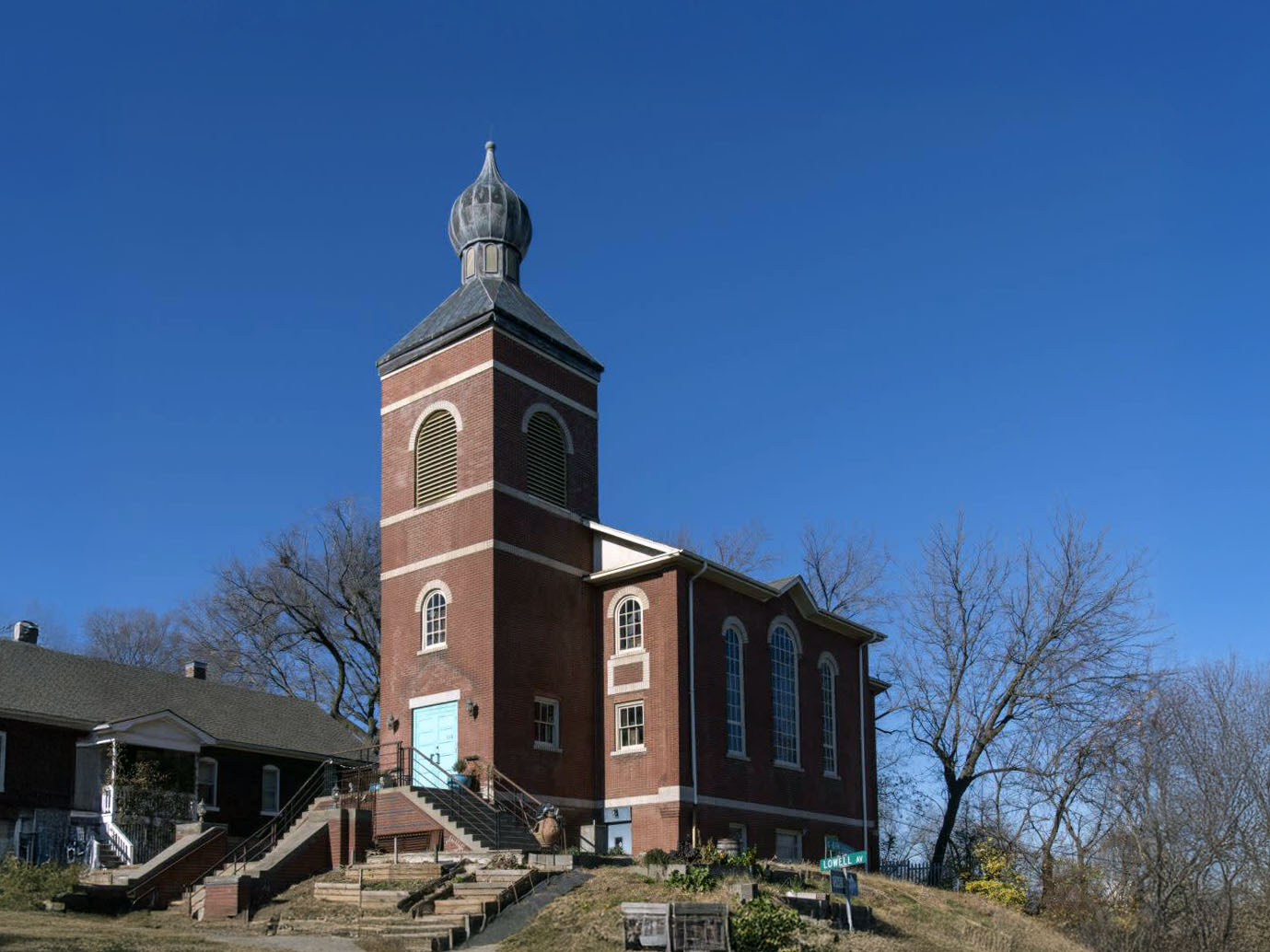
A friend recently sent me several photographs of an unusual red-brick building in the Strawberry Hill neighborhood of Kansas City. At first glance, its identity is unmistakable. A massive square tower rises above the street, and above it sits a small drum crowned by an onion-shaped dome. Whatever happens inside the building today, its architecture still says very clearly: this was an Orthodox church.
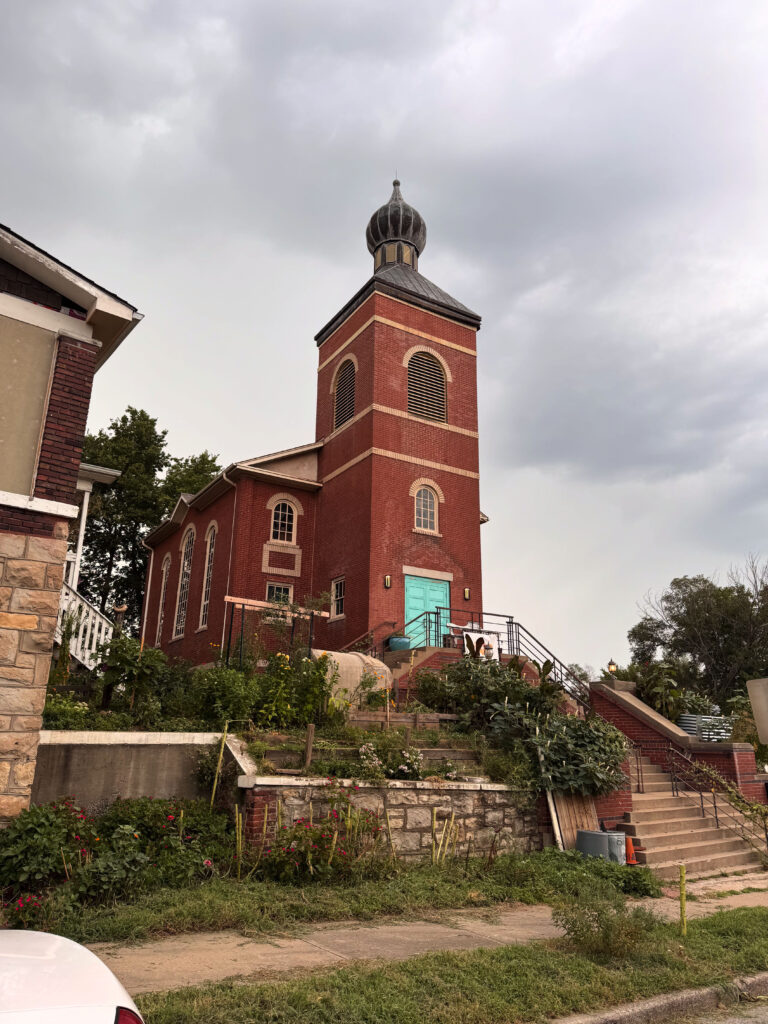
And that makes its present history somewhat painful.
In the Orthodox tradition, a church is never simply a building. When a temple and its altar have received the full rite of consecration, the place is set apart for divine worship. Consecration is not merely an administrative designation that can later be erased because the property has changed ownership. If an Orthodox parish abandons a church, sacred objects, the antimension, and relics associated with the altar must be treated according to ecclesiastical order.
For that reason, the secular reuse of an Orthodox church raises questions quite different from those surrounding an ordinary historic building. There is no simple Orthodox equivalent of changing the zoning classification and declaring that a sacred place has now become ordinary real estate.
I have not yet located the original record showing whether this particular building received the complete rite of consecration or a lesser blessing, and that distinction matters. But if the church was fully consecrated, its subsequent secular use would be especially troubling from an Orthodox perspective.
For anyone familiar with twentieth-century Russian history, the sight also carries an uncomfortable association. Under Soviet rule, thousands of churches were closed and converted into warehouses, clubs, workshops, museums, agricultural buildings, and other secular facilities. The physical building often survived while its sacred function was deliberately erased. Here, of course, the historical circumstances are entirely different. Yet for an Orthodox observer, the visual contradiction remains difficult to ignore.
A Russian Parish on the Kansas Frontier
The building is the former Holy Trinity Russian Orthodox Church, located at 556 Lowell Avenue, Kansas City, Kansasy.
Holy Trinity was founded in 1917 by Russian immigrants living in this part of Kansas City. The neighborhood is generally known today as Strawberry Hill, but the area surrounding the parish was historically also called Russian Hill. The name reflected the presence of Russian and other Eastern European immigrant families who had settled on the hills overlooking the Kansas and Missouri Rivers.
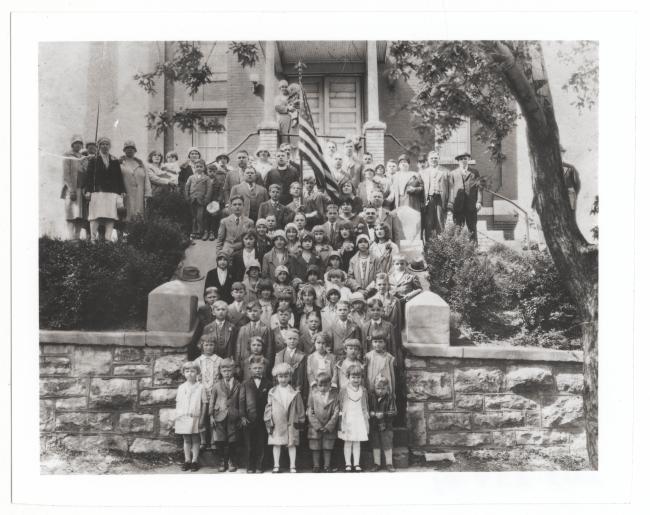
The Kansas Historical Society preserves a remarkable photograph taken around 1920. It shows the congregation assembled on the steps of the church. Men, women, and children stand tightly together in front of the same brick facade that survives today. Another surviving photograph, dated November 16, 1930, records the Holy Trinity church choir. These images give the building something that architectural drawings alone cannot provide: the faces of the community for whom it was built.
Architecturally, the church is particularly interesting because it is not a literal reproduction of a traditional Russian church.
The main volume belongs very naturally to the American architectural environment of the early twentieth century. It is constructed of red brick, with tall round-arched windows, restrained contrasting masonry bands, and a large square frontal tower. Without its upper termination, much of the building could easily be read as a Midwestern Protestant or Catholic church of the same period.
Then comes the decisive element.
Above the square tower rises a small polygonal drum and an onion-shaped dome.
That single gesture changes the identity of the entire composition.
The result is an architecture suspended between two worlds. The body of the church belongs to America; the silhouette remembers Russia. Rather than importing a complete historical style, the builders seem to have worked within local construction traditions and then placed an unmistakably Orthodox sign above them.
For a historian of Orthodox architecture in North America, buildings like this are especially important. They reveal how immigrant communities negotiated between inherited sacred forms and the architectural realities of their new country.
From an Immigrant Parish to an American Orthodox Community
Holy Trinity itself followed an equally characteristic trajectory.
It began as a small Russian-speaking immigrant parish. Over the decades, however, both the neighborhood and the congregation changed. Families moved away from the old urban ethnic districts. Kansas City expanded. New generations were born in America. The parish gradually ceased to be defined primarily by Russian language or ancestry.
Today the parish describes its membership as predominantly American-born and English-speaking, including many converts to Orthodoxy. In other words, the congregation survived precisely because it was able to move beyond the social circumstances in which it had originally been founded.
Eventually, the old church on Russian Hill became too small.
In the late 1990s, the parish sold the building and began the transition to a much larger property in Overland Park, Kansas. The new Holy Trinity Orthodox Church was built at 11901 Pflumm Road. Construction was completed in 2002, and the first service in the new temple was celebrated on Palm Sunday. In 2007, during the parish’s 90th anniversary year, the new church was consecrated by Archbishop Job.
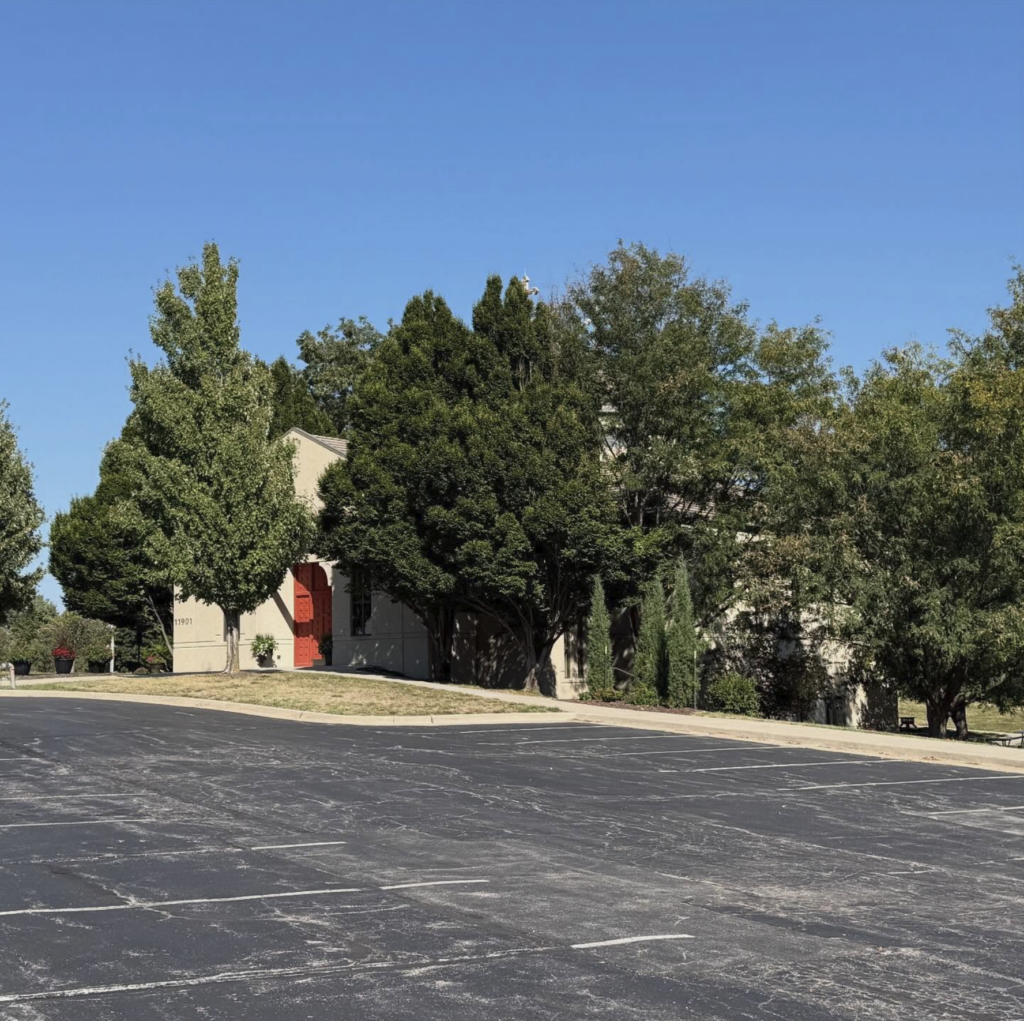
The parish therefore did not disappear. Quite the opposite. It grew out of its original building.
This is an important chapter in the history of American Orthodoxy. The movement from a compact immigrant neighborhood to a large suburban parish reflects a much broader transformation: from an ethnic urban church to a regional American Orthodox community.
The congregation continued its life elsewhere.
The old building remained behind.
The Church Becomes an Aerial Studio
And here the story takes an unexpected turn.
The former Holy Trinity church eventually attracted the attention of Rachel McMeachin, an aerial performer and co-founder of Voler — Thieves of Flight.
According to KCUR, McMeachin discovered the church through a Craigslist advertisement. She visited the building and was immediately taken by the space. For an aerial performer, the former nave offered one particularly valuable architectural quality: height. Its tall interior provided an ideal place to suspend silks, hoops, trapezes, and other aerial equipment.
By July 2012, Voler Aerial Academy announced that its classes and open gym had moved to 556 Lowell Avenue. The organization specifically celebrated the approximately 25-foot-high space of its new home.
More than a decade later, the company is still there.
Its current website continues to list 556 Lowell Avenue, Kansas City, KS 66101 as its address and describes the building, rather strikingly, as its “Urban Church” and “Aerial Church.” The former church now hosts aerial silks, lyra, trapeze, acrobatics, dance, workshops, rehearsals, and performances.
Video from facebook.com (FOX4 News Kansas City)
KCUR reported in 2018 that McMeachin also lived in an upstairs loft within the converted building. Thus the former temple became simultaneously a residence, performance venue, studio, and school.
Architecture Remembers
And yet, from the street, very little has happened to erase the building’s former identity.
The red-brick walls remain. The great arched windows remain. The tower remains. Most importantly, the drum and onion dome still rise above Russian Hill.
That is perhaps the most fascinating and unsettling part of the story.
Buildings have a kind of historical memory. Their function may change. Their owners may change. The people who built them may disappear. Entire neighborhoods may change language, ethnicity, and social character.
But architecture can continue speaking long after the original community has gone.
Holy Trinity on Russian Hill tells several histories at once. It tells the story of Russian immigration to the American Midwest. It records the adaptation of Orthodox architecture to American building traditions. It reflects the gradual transformation of an immigrant parish into an English-speaking American Orthodox community. It documents the postwar movement of urban congregations toward the suburbs.
And finally, it raises a much more difficult question: what happens to sacred architecture when the sacred community leaves?
The congregation of Holy Trinity moved on and built a new church.
The old church remained on the hill.
More than a century after Russian immigrants established their parish there, the onion dome still rises above Lowell Avenue.
Its purpose has changed.
Its architecture has not forgotten.
#Molodin #Malyshev #Apsida #ApsidaStudio #ApsidaFoundation #OrthodoxArchitecture #OrthodoxChurch #ChurchArchitecture #SacredArchitecture #OrthodoxAmerica #AmericanOrthodoxy #RussianOrthodox #RussianAmerica #ChurchHeritage #HistoricChurch #ArchitectureHistory #OrthodoxHistory #KansasCity #StrawberryHill #RussianHill