The Transfiguration Lantern
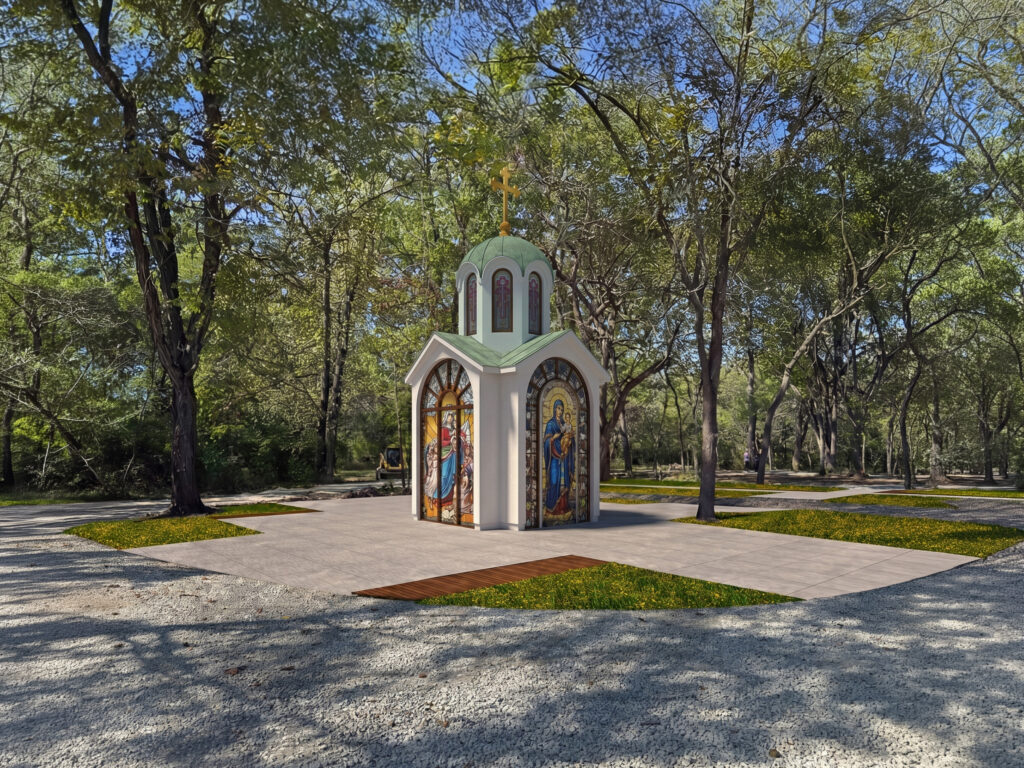
- Project Name: The Transfiguration Lantern: St. Mary of Egypt Cemetery Chapel
- Location: Kansas City, Missouri, USA
- Year: 2025
- Status: Preliminary Proposal / Schematic Design
- Client: St. Mary of Egypt Orthodox Church (Serbian Orthodox Jurisdiction)
- Typology: Orthodox Cemetery Chapel
Architectural & Theological Concept: The Radiant Lantern
This conceptual design for a cemetery chapel is profoundly inspired by the mystery of the Transfiguration, expressing the theological concept of spiritual illumination through built form. Drawing heavily from the Neo-Byzantine architectural heritage of southern Serbia, the design offers a rigorous, historically grounded aesthetic adapted for a modern American context.
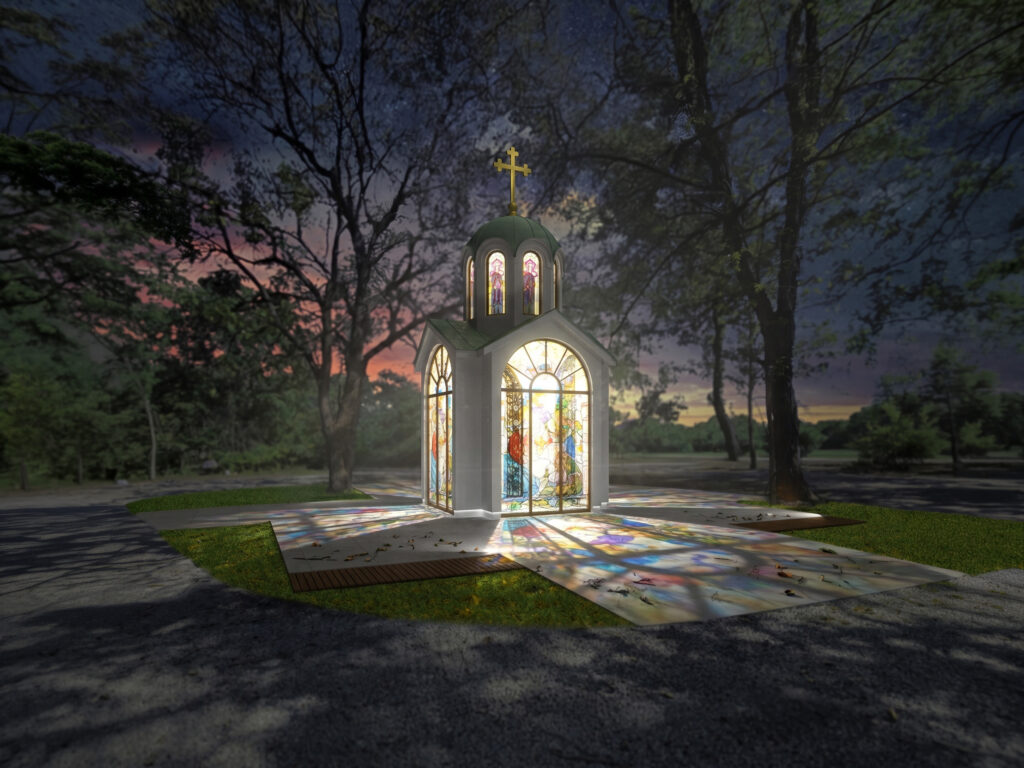
A central tenet of the design is the building’s duality between day and night. During the day, stained-glass elements fill the intimate interior with light and color. At night, utilizing interior illumination, the chapel symbolically turns inside out, transforming into a glowing “lantern” of sacred light. This allows the beauty of Orthodox iconography to radiate outward, becoming a visible beacon of faith to all who pass by the cemetery.
Spatial Organization & Transformability
The chapel is engineered to resolve a common programmatic challenge: providing an intimate space for private mourning while retaining the capacity to host large community gatherings.
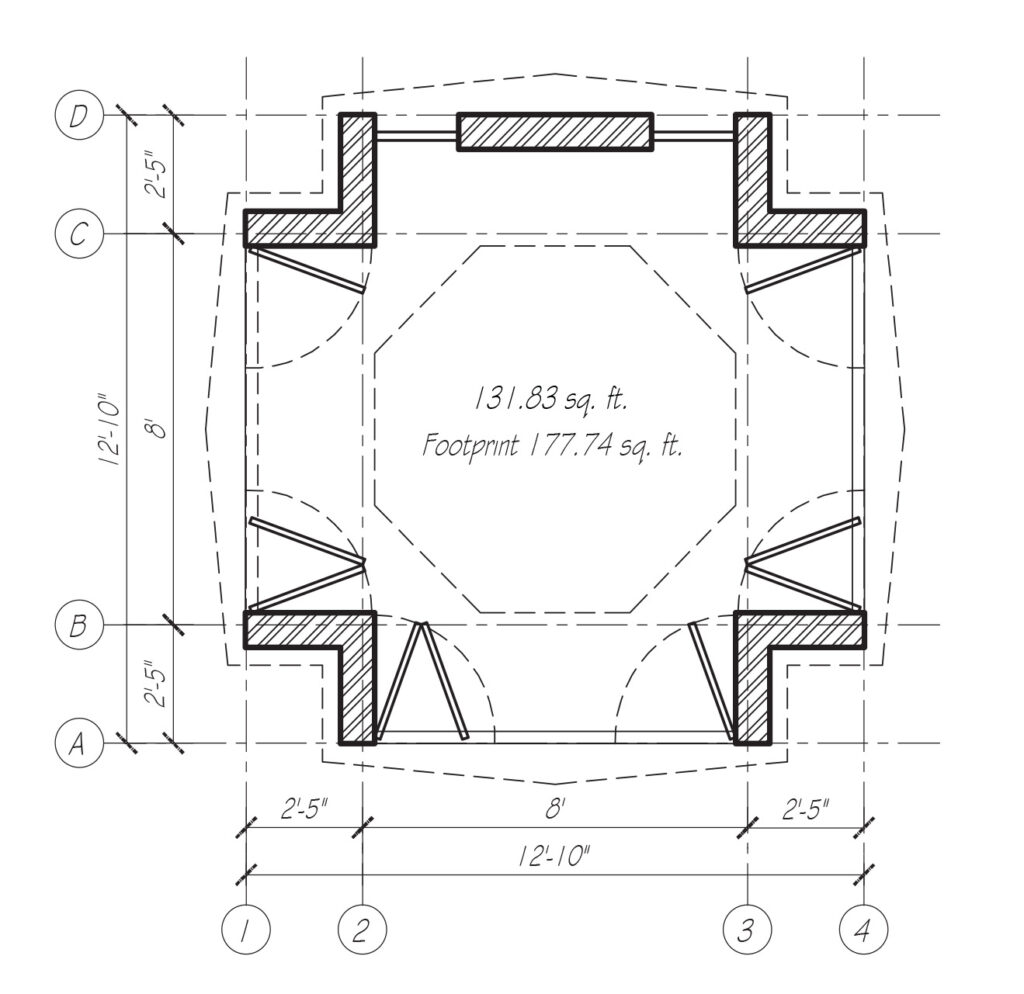
- Classical Morphology: The floor plan adheres strictly to a Greek cross with equal arms, a layout traditional for later-period Orthodox churches. This cruciform base, or tetraconch, is surmounted by an octagonal drum featuring arched panels.
- Dynamic Scalability: The enclosed chapel encompasses approximately 131 square feet, comfortably accommodating up to 18 individuals for private ceremonies. However, the north, south, and west facades feature custom folding glass doors. When fully opened, these panels fold inward, merging the sacred interior with the surrounding landscape and expanding the capacity to accommodate up to 200 participants.
- Iconographic Focal Point: The eastern bay remains solid, serving as the visual anchor of the space. The interior of this wall houses the main icon, while the exterior acts as a canvas for a large-scale mural.
- Permeable Thresholds: The folding door systems operate on a minimal-height floor track, ensuring a completely seamless, barrier-free transition between the interior floor and the exterior terrace.
Tectonic Logic & Materiality
The construction methodology marries traditional masonry aesthetics with efficient, modern structural engineering.
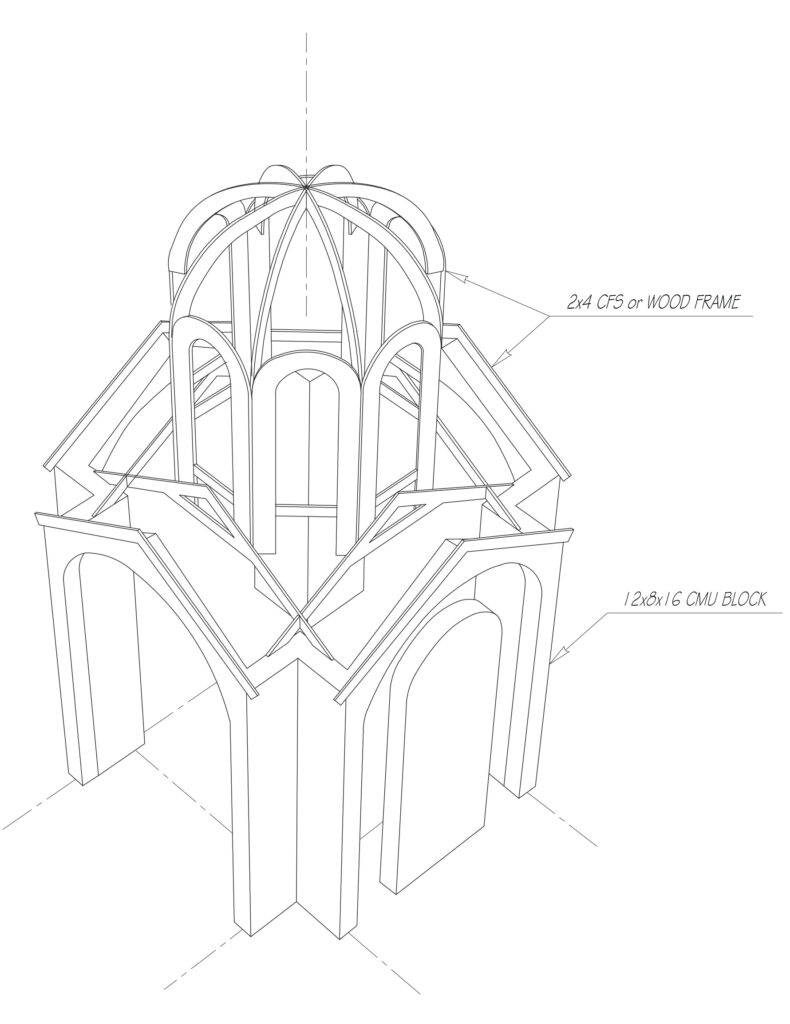
- Substructure & “Floating” Effect: The structure is proposed to rest on drilled cast-in-place concrete piles, tied together by a concrete grade beam. A recessed niche is integrated directly into this grade beam to house concealed linear lighting. At night, this detail creates an optical illusion that the chapel is floating, symbolically alluding to the Ascension of Christ.
- Masonry Superstructure: The primary walls and arches are constructed from standard hollow concrete masonry units (CMU), with critical load-bearing areas reinforced with concrete and vertical rebar. The exterior is finished in warm white stucco, a hallmark of Neo-Byzantine architecture.
- Roof Framing & Dome: The octagonal drum and $7^{\prime}-6^{\prime\prime}$ diameter Byzantine dome are framed using either cold-formed steel (CFS) or light wood framing. The dome is crowned with a gilded orb and Orthodox cross.
- Patinated Roofing: Both the main volume and the dome are clad in flanged copper sheet roofing. Over time, this material will naturally oxidize to a vibrant green patina, offering superior weather protection while visually harmonizing with the surrounding tree canopy.
Landscape & Site Integration
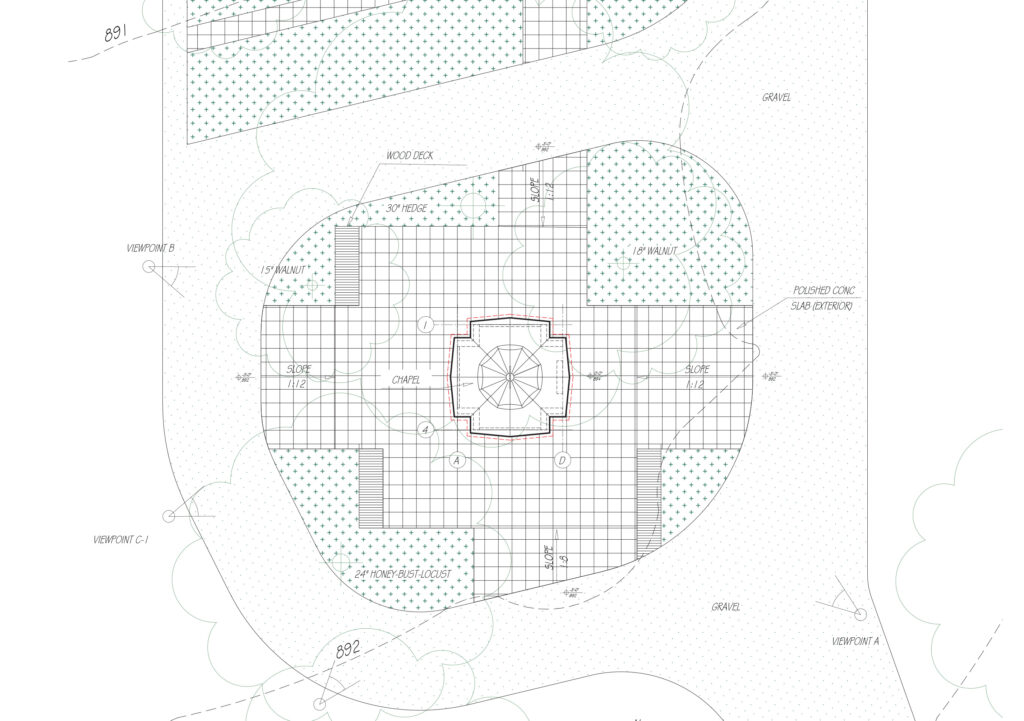
The chapel is strategically sited on a parcel nearest to 58th Street, bordered by a gravel access road, ensuring high visibility and easy vehicular access.
- Elevated Plinth: The landscaped terrace, encompassing roughly 1,832 square feet, is elevated approximately two feet above the adjacent roadway to provide robust stormwater protection.
- Continuous Surface: Finished in polished concrete or natural stone tile, the terrace sits perfectly level with the chapel’s interior floor, visually extending the sacred space outward.
- Accessibility: The elevated platform seamlessly connects to the surrounding grade via gently sloped ramps on all sides, with at least one ramp strictly adhering to ADA 1:12 slope standards, ensuring dignified access for all visitors.