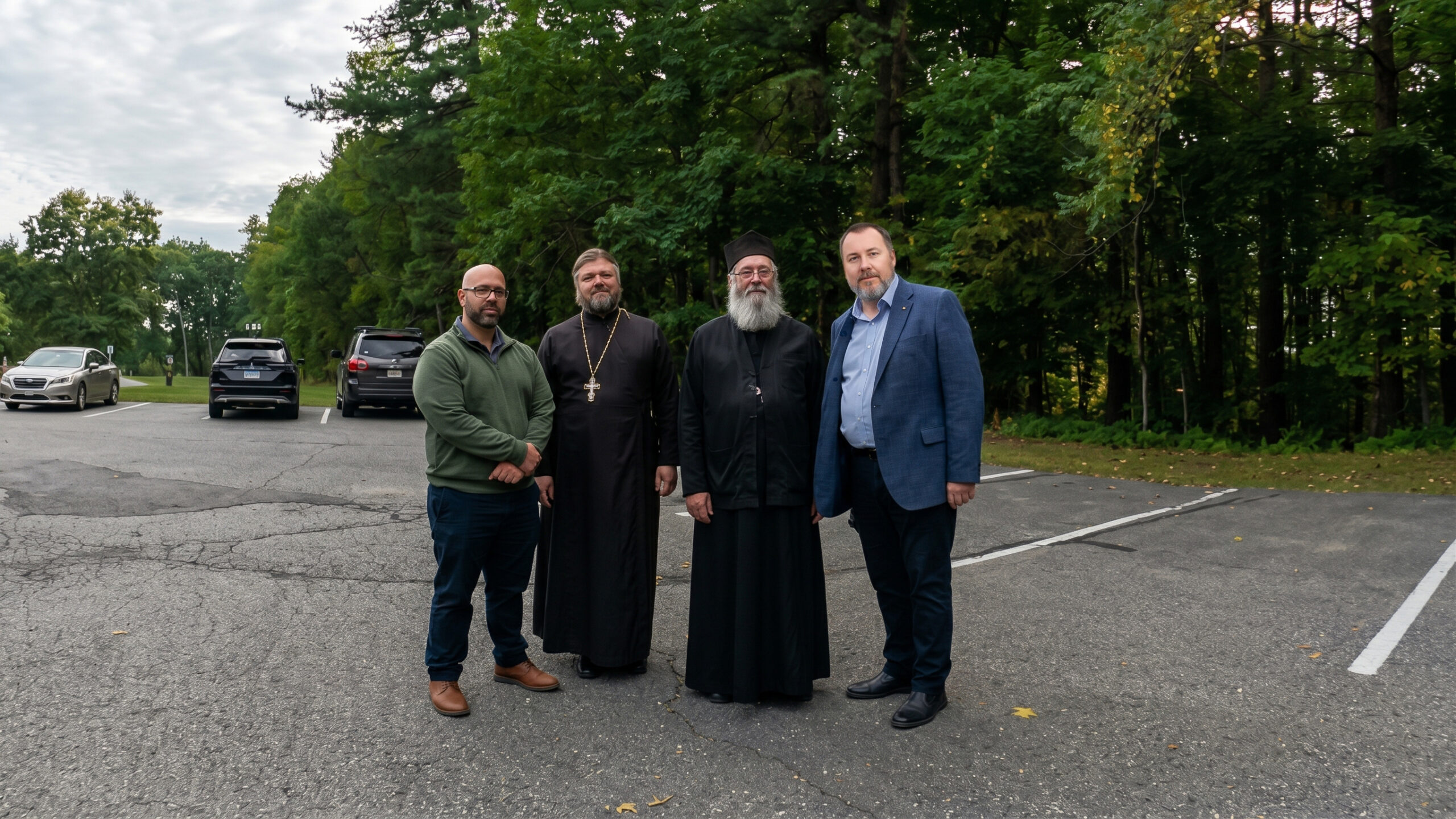
On October 1, Aleksandr Molodin and Andrei Malyshev visited St. Xenia Orthodox Church in Methuen, Massachusetts, where we were warmly welcomed by His Grace Michael, Bishop of Boston and Vicar Bishop of the Eastern American Diocese, who serves as rector of the parish; Priest Alexei Klar, Assistant Rector; and Andrei Doohovskoy, Parish Warden.
St. Xenia Parish has a remarkable history closely connected with the growth of English-language Orthodox Christianity in New England. The community began in the late 1980s as a small mission formed by parishioners from Holy Epiphany Russian Orthodox Church in Roslindale and other Orthodox communities. Its first public service was held on August 13, 1989, in Bradford, Massachusetts. Later that year, the mission moved into a small storefront chapel in Haverhill. After several years of growth, the parish recovered the historic Russian Orthodox cemetery property in Methuen and began construction of its permanent church in June 1995. The congregation moved into the new building in May 1996.
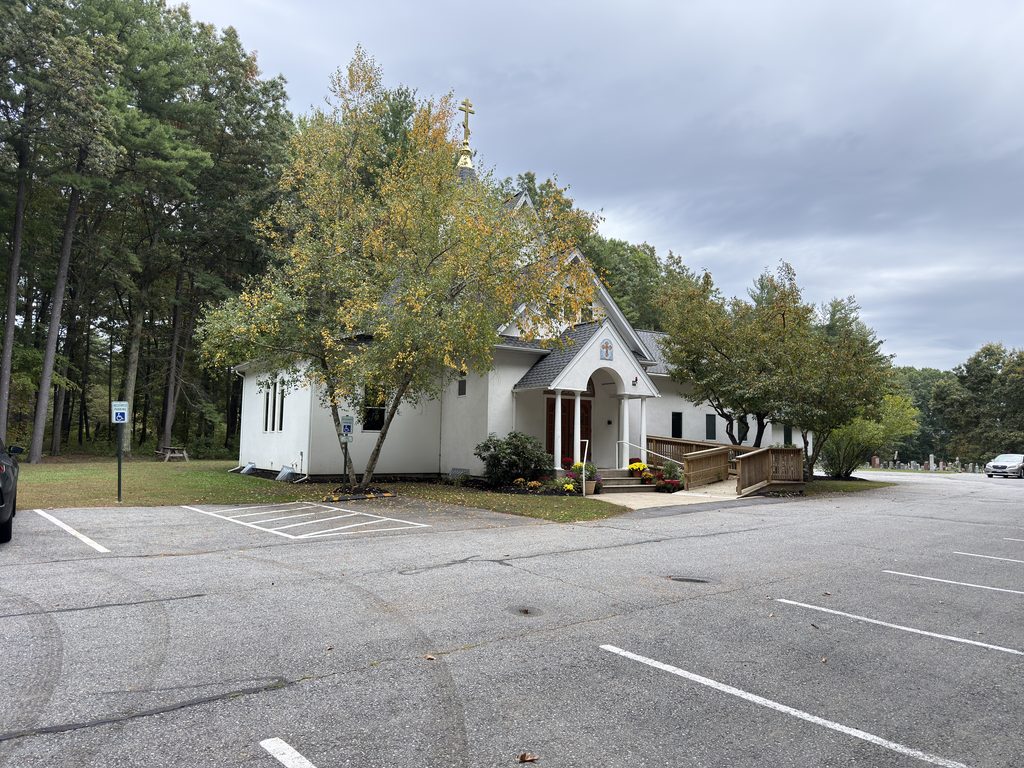
Today, St. Xenia is once again facing the consequences of rapid growth. The parish recently completed a major renovation that nearly doubled the size of the nave and narthex and added much-needed space for meetings, Sunday school, and accessible restroom facilities. Yet the expansion of the church itself effectively eliminated the former parish hall. According to the parish, average Sunday attendance has grown from approximately 140 people in 2018 to around 250 today.
During our visit, the need for additional space was immediately apparent. The parish currently uses its lower level for fellowship meals, but the room is far too small for the congregation. On Sundays, parishioners often have to continue their fellowship outdoors regardless of the weather. The same limited basement space is also used by the church school, which means that classes and other activities must be reorganized whenever the room is needed for the parish meal.
A new and properly designed parish hall and trapeza has therefore become an urgent need. But the challenge goes beyond a single new building. The parish continues to grow, and the existing church may eventually require further expansion or the construction of an additional or larger worship space.
The site makes this an especially interesting architectural problem. Although the parish owns a substantial piece of land, much of it is occupied by the historic Russian cemetery, with the setbacks and protected areas that necessarily accompany it. The remaining developable portion of the property is further complicated by a deep ravine. The task, therefore, is not simply to find a place for a parish hall. It is to develop a comprehensive architectural strategy for the long-term growth of the entire parish: church, fellowship hall, school, circulation, parking, accessibility, landscape, and cemetery must all be considered as parts of a single composition.
There is another important dimension to the project. St. Xenia is the parish where His Grace Bishop Michael serves as rector. Any future development must therefore respond not only to practical needs, but also to the particular significance of the place within the life of the Diocese.
It is a complicated site, a rapidly growing congregation, and a program that must anticipate needs well beyond the present moment.
In other words, this architectural problem is a tough nut to crack.
Exactly the kind of challenge we love.